
The Federal Reserve’s policy committee holds eight scheduled meetings a year. Monero’s supply schedule holds none. It’s written in the code.
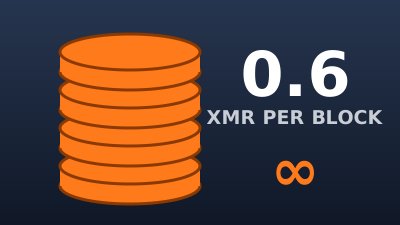
Since block 2,641,623, mined on 9 June 2022, every Monero block has carried a base reward of 0.6 XMR for its miner. The code keeps it at 0.6 XMR per block. FOREVER.
That’s the tail emission. Here is how it works, why it exists, and why its inflation rate falls every single year.
The Numbers, Straight From The Code
Monero’s source code sets the floor at 0.3 XMR per minute, in a constant called FINAL_SUBSIDY_PER_MINUTE. Blocks target 2 minutes. So the floor is 0.6 XMR per block.
You can see the switch on the chain. Block 2,641,622 paid a base reward of 0.600000145281 XMR. The next block, 2,641,623, paid exactly 0.6.
The reward can dip below 0.6 XMR in one case. Moneropedia says rewards stay at “0.6 XMR or less* per block,” and the asterisk reads: “Due to block size penalties.” Under the reward code, a block that is heavier than the recent median pays its miner less.
At 720 blocks a day, that’s about 432 new XMR a day, or about 157,800 a year.
Before the tail, the main emission curve paid out about 18.132 million XMR. By our arithmetic, about 18.82 million XMR existed on 18 October 2026.
Why Never Stop? Pay The Guards
Miners secure the chain with their hashrate. Moneropedia states the problem plainly:
“Miners need an incentive to mine. Because of the dynamic blocksize, competition between miners will cause fees to decrease. If mining is not profitable due to a high cost and low reward, miners lose their incentive and will stop mining, reducing the security of the network.”
So Monero pays a floor. The FAQ says Monero keeps a block reward “rather than relying solely on the transaction fees to give the miners incentive to keep securing the network with their hashrate, and keep transaction fees low.”
Bitcoin took the other road. Its issuance halts at 21 million coins. Then, says bitcoin.org, “Bitcoin miners will probably be supported exclusively by numerous small transaction fees.”
Monero chose a fixed, public paycheck for the people who guard the chain.
The Rate Falls Every Year
The reward stays at 0.6 XMR. The pile it lands on keeps growing. So the percentage drops, year after year.
By our arithmetic (about 157,800 new XMR a year, divided by the supply at the time):
- First year of the tail, from June 2022: about 0.87%
- October 2026: about 0.84%
- 2030: about 0.82%
- 2050: about 0.70%
- 2100: about 0.52%
getmonero.org sums it up as “<1% inflation, with the percentage trending towards 0 over time.”
And you don’t have to take it on trust. Amounts are hidden, but the FAQ says observers “can do math on the Pedersen commitments to determine that no Monero was created out of thin air.” Its verdict: “The fixed emission of the currency ensures human corruption cannot over inflate the supply.”
Now Look At The Central Banks
The technocrats at the central banks set their goals in committee.
The Federal Reserve’s Federal Open Market Committee has twelve members. It “judges that inflation of 2 percent over the longer run” is “most consistent with the Federal Reserve’s mandate for maximum employment and price stability.”
The European Central Bank’s Governing Council, after its July 2021 strategy review, aims “for 2% inflation over the medium term.”
Be clear on what that means. Their 2% is a goal for rising prices, not a count of new coins, so the two numbers measure different things. But the GOAL is in writing: prices up about 2% a year, over the long run.
That committee also sets the objective for the Fed’s “open market operations,” its buying and selling of securities. The Fed’s total assets stood at $4.24 trillion on 4 March 2020. By 13 April 2022, they hit $8.97 trillion, more than double, according to Federal Reserve data on FRED.
Could Monero’s rule change? Only through a hard fork, a consensus change that the network’s nodes must choose to run. No committee meets eight times a year to set it.
Their balance sheet answers to a committee. Monero’s supply answers to the code: 0.6 XMR a block.
Hold The Coins Yourself
A fixed schedule protects you only if you hold your own keys. Keep XMR in a self-custody wallet such as Monero One. Full disclosure: the host built Monero One. He’s biased. He’s also right.
How do hidden amounts square with a supply anyone can audit? Read Monero vs Bitcoin privacy.
Follow @MoneroOne on X and join the Resistance on Telegram (t.me/monero_one).
SOURCES
- getmonero.org: FAQ (maximum supply, tail emission start block)
- Moneropedia: Tail emission
- getmonero.org: About Monero (main curve, ~18.132 million)
- Monero source: emission constants (cryptonote_config.h)
- Monero source: block reward and size penalty (cryptonote_basic_impl.cpp)
- xmrchain.net: block 2,641,622
- xmrchain.net: block 2,641,623
- xmrchain.net: Monero block explorer (chain height)
- Bitcoin.org: FAQ
- Federal Reserve: About the FOMC
- Federal Reserve: Why does the Federal Reserve aim for inflation of 2 percent?
- Federal Reserve: Open market operations
- ECB: Price stability and the 2% target
- FRED, Federal Reserve Bank of St. Louis: Fed total assets (WALCL)
Join the resistance in style: get Monero One at no cost. It stays free.


Comments
Talk about this story with the resistance on Telegram.
Join the discussion