
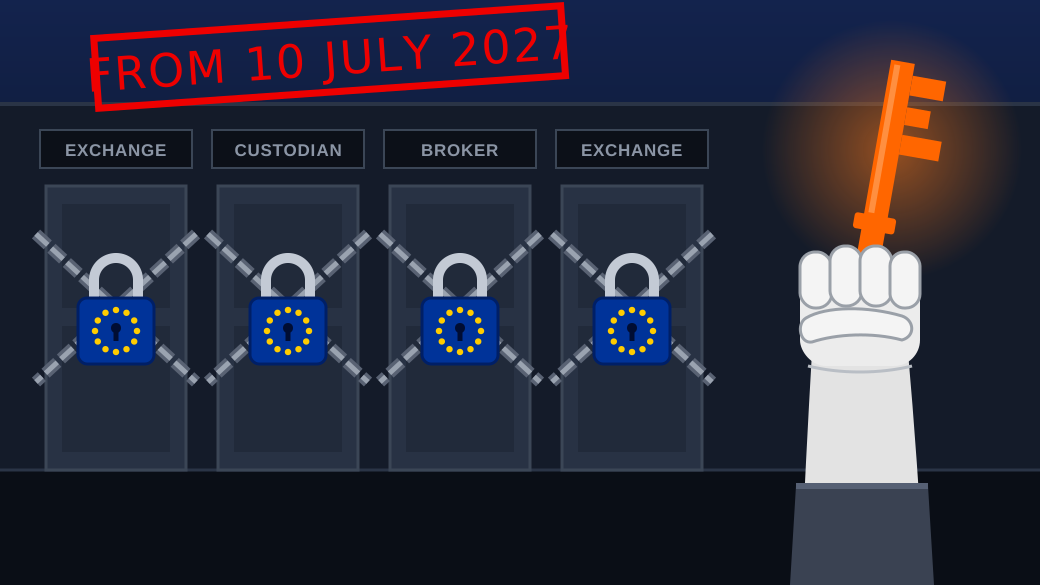
UPDATE, 19 October 2026: The rule still applies from 10 July 2027: Article 90 says “It shall apply from 10 July 2027” (Springlex). On 1 October 2026 AMLA said it had submitted three final draft standards to the European Commission, among them customer due diligence; they bind only after the Commission adopts them (AMLA). A CryptoTicker check on 5 October 2026 found no XMR pairs at Bitpanda, Bitvavo, Coinbase, Bitstamp or OKX, and Kraken’s XMR pairs blocked in the EEA (CryptoTicker), while Coinbase and Kraken hold MiCA authorisations (Tech Insider). KuCoin EU Exchange GmbH holds an Austrian MiCA authorisation, but on 18 May 2026 the FMA said “commencement of business operations still remains inadmissible” (FMA).
The Brussels bureaucrats have a brand-new money watchdog in Frankfurt. And the EU rulebook it will help enforce goes after the coins built to keep your payments private.
On 1 July 2025, the EU’s Anti-Money Laundering Authority, AMLA, began operations at its seat in Frankfurt.
Its tasks, in its own words, include “directly supervising selected financial sector entities that operate on cross border basis and present high risk of money laundering and terrorism financing, as well as indirectly supervising other entities in the financial and non-financial sectors.”
It will also coordinate Europe’s Financial Intelligence Units and manage their shared FIU.net information system.
Who asked for that?
Now read the rulebook. Article 79(1) of the EU’s Anti-Money Laundering Regulation, Regulation (EU) 2024/1624, published on 19 June 2024, says:
“Credit institutions, financial institutions and crypto-asset service providers shall be prohibited from keeping anonymous bank and payment accounts, anonymous passbooks, anonymous safe-deposit boxes or anonymous crypto-asset accounts as well as any account otherwise allowing for the anonymisation of the customer account holder or the anonymisation or increased obfuscation of transactions, including through anonymity-enhancing coins.”
“Including through anonymity-enhancing coins.” They put it in WRITING.
The text never names Monero. It doesn’t have to. Crypto press coverage reads “anonymity-enhancing coins” as Monero and Zcash.
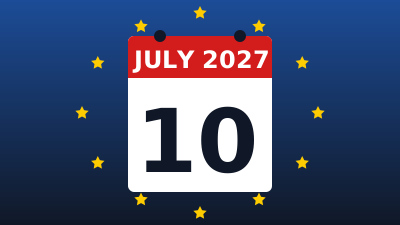
The rule applies from 10 July 2027. Mark the date.
The technocrats already have a companion rule on the books. Article 76(3) of MiCA, the EU’s crypto-markets law, says a trading platform’s operating rules “shall prevent the admission to trading of crypto-assets that have an inbuilt anonymisation function unless the holders of those crypto-assets and their transaction history can be identified.”
Translation: show them who holds it and where it has been, or it does not trade.
As we have warned, the big doors have been closing one by one.
OKX dropped its Monero pairs in early January 2024, saying they did “not meet our criteria.” Binance delisted Monero on 20 February 2024 and gave no detailed explanation.
Then Kraken shut off Monero trading and deposits across the European Economic Area on 31 October 2024. Kraken said it “concluded we have no choice but to delist Monero (XMR) in the European Economic Area (EEA) due to regulatory changes.”
No choice. Their words.
And the surveillance state is watching your withdrawals, too. Since 30 December 2024, under Article 14 of the EU’s Transfer of Funds Regulation, an exchange that sends more than EUR 1,000 to a self-hosted address “shall take adequate measures to assess whether that address is owned or controlled by the originator.”
Your wallet. Your coins. Their check.
What Brussels Did NOT Ban
Here is what the scare headlines get wrong.
Article 79 binds credit institutions, financial institutions and crypto-asset service providers. It does not bind you.
- It does not ban owning or holding Monero.
- It does not ban self-custody, or a self-custody wallet like Monero One.
- It does not ban mining or running a node.
- It does not ban peer-to-peer trades between people.
Even AMLA spells out its limits: “AMLA will not issue fines, fees or sanctions on individual citizens.”
Own it? Fine. Use a licensed door to it? Forbidden.
How To Keep Your Own Keys
The coins you hold yourself stay in your hands. Here is how to hold them.
- Use a self-custody wallet, so the keys live on your own device and not in an exchange’s back office. Monero One is one. Full disclosure: the host built Monero One. He’s biased. He’s also right.
- Write your seed words on paper and keep them offline. Never type them into a website. Never read them out to “support.”
- Need to show your accountant what came in? Share a view key. It lets someone “view every incoming transaction.” Your seed and your spend key stay with you.
- Watch the delisting deadlines. When Kraken dropped Monero in the EEA, it converted the Monero that customers left behind into Bitcoin. Here is what to do when an exchange delists Monero.
- Guard your IP address. After a Chainalysis video leaked in 2024, a Monero community expert told Decrypt that “protecting your IP address is key,” and advised running your own node or using Tor.
The globalists in Brussels are locking the licensed doors. The keys in your pocket are still yours.
This is not legal advice.
Follow @MoneroOne on X and join the Resistance on Telegram (t.me/monero_one).
SOURCES
- EUR-Lex: AMLR, Regulation (EU) 2024/1624, official text
- Springlex: AMLR Article 79
- Springlex: AMLR Article 90
- Springlex: MiCA Article 76
- Springlex: TFR Article 14
- AMLA: About AMLA
- Wikipedia: AMLA
- Cointelegraph: EU privacy token ban
- ForkLog: OKX delists privacy coins
- Decrypt: Binance delists Monero
- Decrypt: Kraken delists Monero in the EEA
- Moneropedia: View key
- Decrypt: Chainalysis video fact-check
- AMLA: AMLA finalises key standards for the private sector (press release, 1 October 2026)
- CryptoTicker: Buying Monero in Germany
- Tech Insider: MiCA-licensed crypto exchanges (24 July 2026)
- FMA: ban on new business lifted for KuCoin EU Exchange GmbH (18 May 2026)
Join the resistance in style: get Monero One at no cost. It stays free.
Comments
Talk about this story with the resistance on Telegram.
Join the discussion