
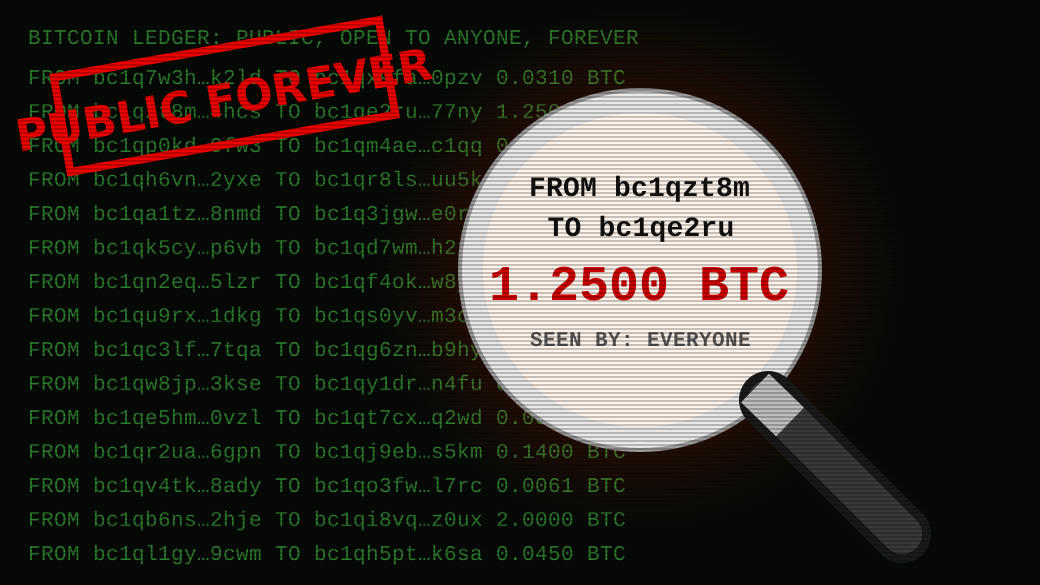
Bitcoin’s own website admits it: “All Bitcoin transactions are public, traceable, and permanently stored in the Bitcoin network.”
Every payment. Public. FOREVER.
Monero was built to work the other way.
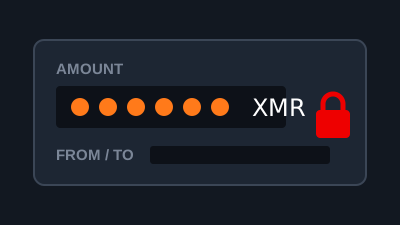
Monero is a digital currency that hides the sender, the receiver and the amount by default. You don’t flip a privacy switch. The project set minimum ring sizes “so that all transactions were private by mandate,” in its own words.
Its coin is XMR. And “Monero” is simply the Esperanto word for “coin,” according to the project’s FAQ.
So why do the Brussels bureaucrats want it off the licensed exchanges? Read on.
Born In April 2014. No Premine.
Monero launched in April 2014. The project describes it as “a fair, pre-announced launch of the CryptoNote reference code. There was no premine or instamine, and no portion of the block reward goes to development.”
No premine means nobody handed themselves a stash of coins before the public could mine. Every XMR in existence came out of a mined block, in the open.
Three Locks On Every Payment
Monero hides a payment with three tools. Each tool covers one part of it.
1. Stealth addresses hide the receiver. You can hand out one address. But each payment to you lands on a new one-time address on the blockchain. Moneropedia says those addresses “cannot be linked back to either the recipient’s published address or any other transactions’ addresses.”
2. Ring signatures hide which coin was spent. Your wallet signs with your real coin plus 15 decoys taken from the blockchain. That makes a ring of 16, the size since the network upgrade of 13 August 2022. Moneropedia: “There is no way an outside observer can tell which of the possible signers in a signature group belongs to your account.”
3. RingCT hides the amount. RingCT, short for Ring Confidential Transactions, “is how transaction amounts are hidden in Monero.” It arrived in January 2017 and became mandatory for all transactions after September 2017.
Sender. Receiver. Amount. Since September 2017, every new transfer between Monero wallets hides all three.
What The Watchers CAN Still See
Nobody honest promises magic. Monero’s own FAQ says it plainly: “Monero is not magic.” It also warns: “Attacks only get better.”
Here is what an outside observer can still see:
- That a transaction happened. Public explorers such as xmrchain.net list every block with its transactions, fees and ring members. They show no transfer amounts and no wallet addresses.
- The 16 candidates in each ring, and the odds. getmonero.org itself says rings “in general enable statistical analysis (mitigated by distribution of the decoy selection algorithm).” The planned FCMP++ upgrade is meant to remove that weak spot.
- Your IP address, if you hand it to the wrong node. After a Chainalysis video leaked in September 2024, a Monero community figure told Decrypt: “protecting your IP address is key, as that’s primarily what they can obtain.” The advice: run your own node or use Tor.
- Whatever you hand over yourself. An exchange that checked your ID keeps your records. The Coinbase data stolen in May 2025 included “images of government IDs” and “account data such as transaction histories,” The Record reported.
On the chain itself, the amounts stay hidden, and so do the receivers’ addresses. Moneropedia says no outside observer can tell which ring member is real. The risk is statistical, as getmonero.org says above.
The US tax agency has put money on the question. On 30 September 2020, the IRS gave Chainalysis and Integra FEC contracts worth up to $625,000 each to build Monero tracing tools, Decrypt reported. We found no public result.
Who Runs It? Nobody Owns It.
No company. No CEO. The FAQ calls Monero “an open source community project,” with “no company who runs it and there is no CEO who hires people.”
The code is public on GitHub, where more than 300 people have contributed to the main repository. A Core Team “has provided oversight” since the project split from its original founder. Developers post their meeting logs in public on GitHub, week after week.
And the money? “No portion of the block reward goes to development.” Donors pay for the work through the Community Crowdfunding System. One example: 56 contributors funded a 500 XMR audit of the FCMP++ upgrade code.
Who Mines It
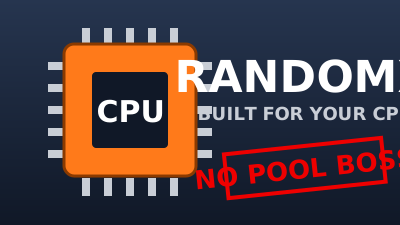
Anyone with an ordinary computer can try. Since block 1,978,433 on 30 November 2019, Monero has used RandomX, “a proof-of-work (PoW) algorithm that is optimized for general-purpose CPUs.”
That’s by design. The project says its algorithm “prevents specialized mining hardware from dominating the network.”
A new block arrives about every 2 minutes. And “Monero gives the full block reward to the miners.”
How Many Coins Exist?
The main emission curve paid out about 18.132 million XMR. Then the tail emission began: since block 2,641,623 on 9 June 2022, each block pays a fixed 0.6 XMR. Forever.
That’s about 432 new XMR a day. By our arithmetic, about 18.82 million XMR existed on 18 October 2026. The yearly rate is under 1%, and it falls as the supply grows.
Anyone can check the total. Amounts are hidden, but the FAQ says observers “can do math on the Pedersen commitments to determine that no Monero was created out of thin air.”
The Doors Are Closing
As we have warned, the big exchanges have dropped Monero one by one:
- OKX dropped its Monero pairs in early January 2024, saying they did “not meet our criteria.”
- Binance delisted Monero on Tuesday, 20 February 2024, without a detailed explanation.
- Kraken halted Monero trading and deposits in the European Economic Area on 31 October 2024. It said it had “no choice but to delist” there “due to regulatory changes.”
- Kraken then said it would end XMR trading for Canadian clients on 2 September 2025, citing “recent compliance requirements in Canada.”
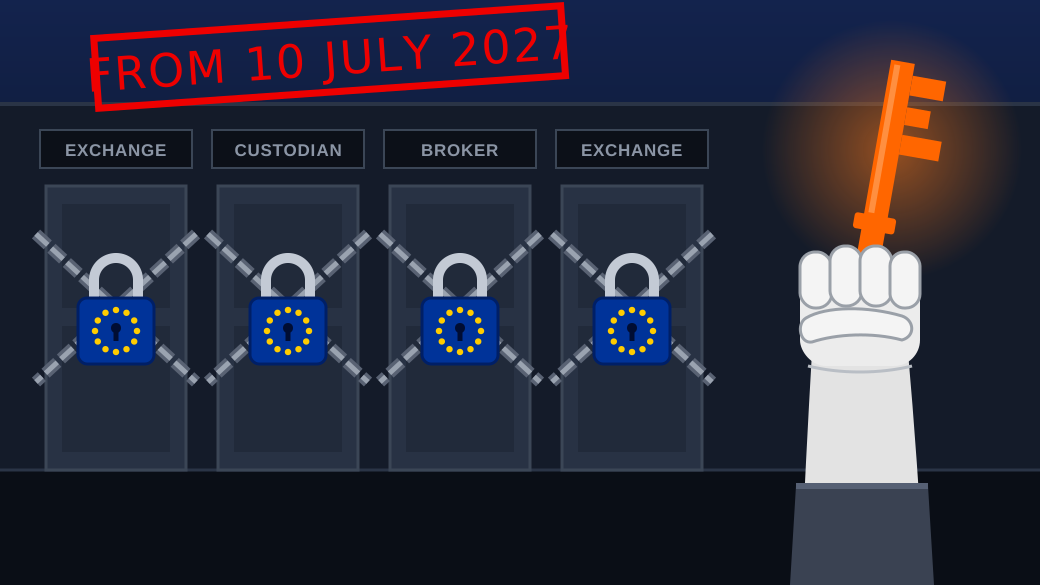
Now the Brussels bureaucrats have put it in law. Article 79(1) of the EU’s Anti-Money Laundering Regulation bars credit institutions, financial institutions and crypto-asset service providers from keeping any account that allows “the anonymisation or increased obfuscation of transactions, including through anonymity-enhancing coins.”
It applies from 10 July 2027. Who asked for that?
Article 79 never names Monero. Cointelegraph reads it as covering coins “such as Monero (XMR) and Zcash (ZEC).”
In The EU, Owning It Stays Legal
Here is what the scare headlines skip. Article 79 binds providers. It does not bind you.
- It does not ban owning or holding Monero.
- It does not ban a self-custody wallet.
- It does not ban mining or running a node.
Even the EU’s new money-laundering authority, AMLA, says: “AMLA will not issue fines, fees or sanctions on individual citizens.”
Own it? Fine. Use a licensed door to it? Brussels is closing those doors.
Laws differ by country, so check yours. This is not legal advice.
How To Get It, And How To Keep It
Start with a self-custody wallet, so the keys stay on your own device. Monero One is one. Full disclosure: the host built Monero One. He’s biased. He’s also right.
Then get the coins. The FAQ lists the main routes: “You can buy Monero from an exchange or from an individual.” Some wallets can swap other coins for it. Or you can mine it. For the buying routes, read where to buy Monero.
A word on ID checks. If an exchange asks for your ID, that’s KYC, “know your customer.” Your ID then sits in their files. Remember Coinbase in May 2025.
Then keep it safe:
- Write your seed words on paper and keep them offline. The FAQ is blunt: “If you backup your seed in the cloud, you’ll be poorer soon.”
- Never type your seed into a website. Never read it out to “support.”
- Guard your IP address with your own node or Tor.
The globalists in Brussels can close the licensed doors. The keys in your pocket are still yours.
Follow @MoneroOne on X and join the Resistance on Telegram (t.me/monero_one).
SOURCES
- Bitcoin.org: Protect your privacy
- getmonero.org: FAQ
- getmonero.org: About Monero
- Moneropedia: Stealth address
- Moneropedia: Ring signature
- Moneropedia: RingCT
- Monero 0.18.0.0 release: ring size 16 from the 13 August 2022 upgrade
- getmonero.org: Full-Chain Membership Proofs development (27 April 2024)
- xmrchain.net: Monero block explorer
- Decrypt: Monero expert fact-checks the Chainalysis video (10 September 2024)
- The Record: Coinbase extortion attempt (15 May 2025)
- Decrypt: IRS awards contracts to trace Monero (30 September 2020)
- GitHub: Monero contributors
- GitHub: Monero meeting logs (monero-project/meta)
- Monero CCS: FCMP++ Integration Audit
- Monero source: mainnet hard fork heights (hardforks.cpp)
- getmonero.org: Roadmap (RandomX, November 2019)
- GitHub: RandomX
- ForkLog: OKX delists privacy coins
- Decrypt: Binance delists Monero (20 February 2024)
- Kraken: Support for Monero (XMR) in Europe
- Kraken: Notice of delisting XMR, Canada
- EUR-Lex: AMLR, Regulation (EU) 2024/1624, official text
- AMLR Article 79, Official Journal text mirror (Springlex)
- AMLR Article 90, entry into force and dates (Springlex)
- Cointelegraph: EU privacy token ban
- AMLA: About AMLA
Join the resistance in style: get Monero One at no cost. It stays free.

Comments
Talk about this story with the resistance on Telegram.
Join the discussion